






Car Charger for Car, Motorcycle, Truck
Filter
Sort by:




Battery chargers for cars, motorcycles, and trucks: trickle charger or battery charger?
These are two different needs, and it is worth clarifying them immediately. A trickle charger (maintainer) remains connected for weeks and compensates for self-discharge: it is what a motorcycle needs when stored for the winter, a camper in storage, or a vintage car. A battery charger has more current and is used to recharge a battery that is already flat within a reasonable amount of time. Many modern devices do both, but the choice of amperage changes significantly depending on which of the two you actually need.
How many amperes are needed
The rule of thumb is simple: the ideal charging current is around 10% of the battery's capacity in ampere-hours. A 12 Ah motorcycle battery works well with approximately 1.2–2.5 A; a 60 Ah car battery requires about 6 A; on a heavy vehicle with 100 Ah or more, you need at least 10 A to avoid spending the night charging. Going well below means very long times, while going well above heats the battery and shortens its life.
Selection table
| Vehicle | Typical battery | Recommended current | Primary use |
|---|---|---|---|
| Motorcycle, scooter, quad | 6V or 12V, 4–20 Ah | approx. 2.5 A | Maintenance during storage |
| Small and medium-sized car | 12V, 45–70 Ah | approx. 6 A | Charging and maintenance |
| SUV, camper, boat | 12V, 70–100 Ah | 8–10 A | Service charging |
| Truck and commercial vehicles | 24V (two batteries in series) | 10 A with 24V output | Professional charging |
The detail that is forgotten: the battery type
A modern battery charger must be able to recognize the chemistry it is dealing with. Traditional lead-acid, AGM, and GEL batteries require different charging profiles, and LiFePO4 (lithium iron phosphate, increasingly common on motorcycles and light vehicles) have end-of-charge voltages that a lead-only charger cannot handle: using one on a lithium battery can damage it. Always check that the model states it has a lithium mode if you need it.
Also pay attention to voltage: 6V for vintage motorcycles and old vehicles, 12V for almost all cars and motorcycles, 24V for heavy-duty vehicles. A 12V charger will not charge a 24V system.
Expert advice. If the motorcycle sits idle all winter, don't wait for spring to realize the battery is dead. A lead-acid battery left discharged for months will sulfate and will never be as good as before: a trickle charger costs less than a new battery. Leave the eyelet cable installed on the terminals so you can connect the charger with a plug without having to remove anything every time.
Accessories and emergency jump starters
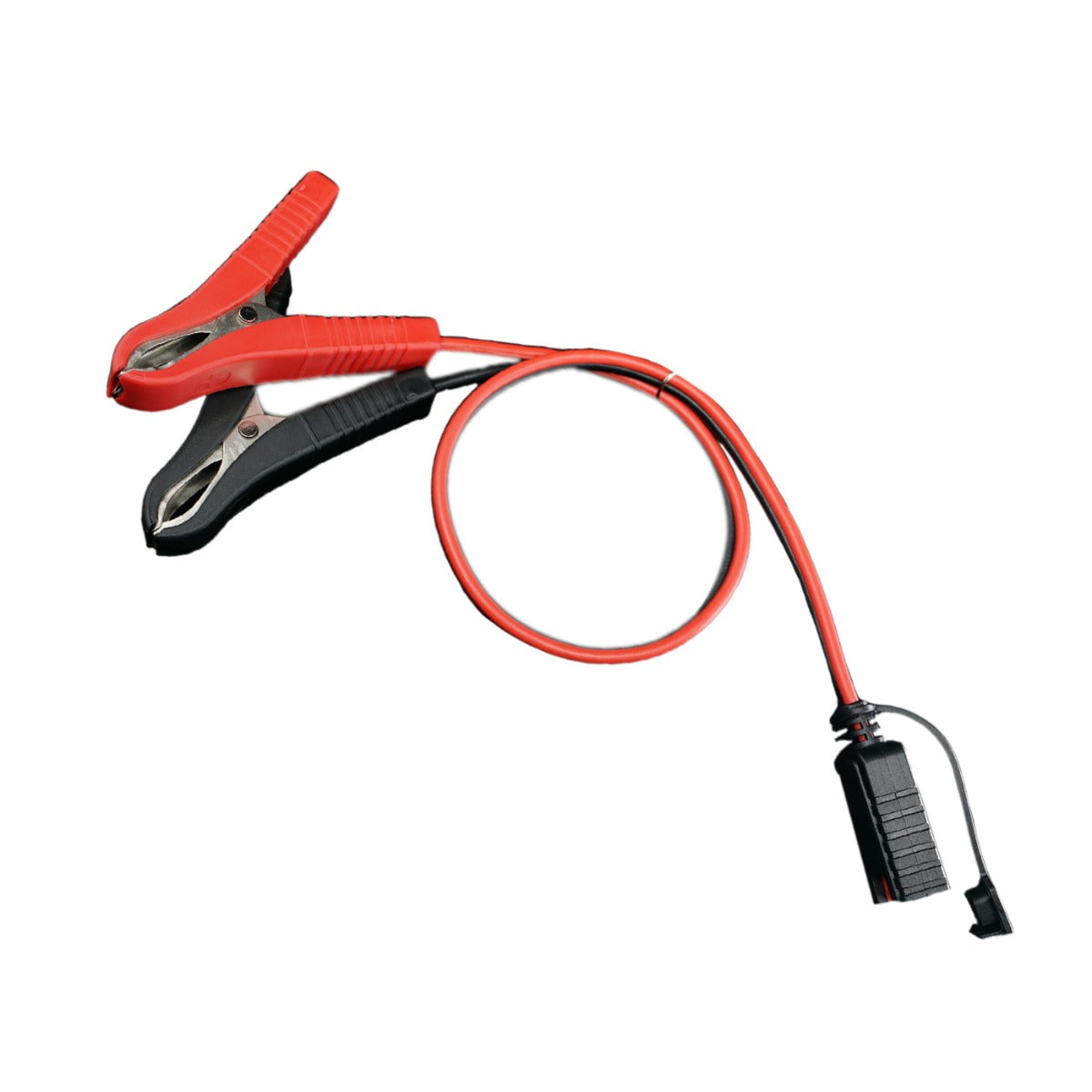
In this section, you will also find accessories that make daily use practical: cables with alligator clips for quick connection, eyelet cables to leave fixed to the battery, and distribution hubs that allow a single charger to service multiple vehicles in sequence — useful in a workshop or garage with multiple motorcycles.
An emergency jump starter (booster) is different: it does not charge the battery; it provides the surge of current necessary to start the engine when you are already stranded. It is an accessory to keep in your car, not a replacement for a battery charger.
Frequently asked questions
Can I leave the charger connected for weeks?
Only if the model has a maintenance (trickle) function, i.e., if it switches to a float voltage after charging and stops outputting power when not needed. Old-generation chargers without electronic control continue to push current and lead to battery overcharging.
Do I have to disconnect the battery from the vehicle before charging it?
With a modern electronic charger, it is usually not necessary. However, observe the connection order: first the terminals to the battery, then the plug to the socket; do the reverse when charging is finished.
Is a lead-acid battery charger suitable for lithium batteries?
No, unless it explicitly declares LiFePO4 mode. The end-of-charge voltages are different, and the wrong profile can damage the cells or trigger their protection system.
How long does a full charge take?
Divide the ampere-hour capacity by the charger's current and add about 20%, because the current drops in the final phase. A 60 Ah battery half-discharged, with a 6 A charger, takes approximately six hours.
The battery discharges again after a few days: is it the charger's fault?
Almost never. Either the battery is at the end of its life and no longer holds a charge, or there is a parasitic drain on the vehicle. If in doubt, it is better to measure the resting voltage twelve hours after charging before buying any accessories.
For replacement batteries, see the batteries section; for bench power supplies and stabilized sources, see power supplies.


